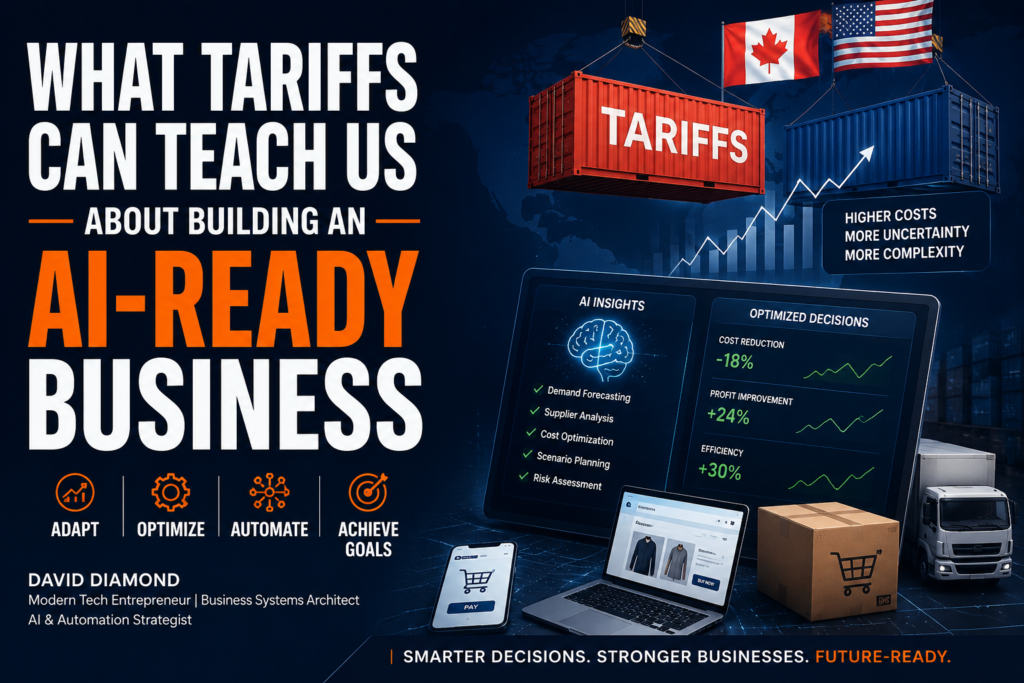
What Tariffs Can Teach Us About Building an AI-Ready Business
A tariff can change the economics of a business overnight.
A product that was profitable yesterday can suddenly become difficult to sell today.
A supplier that made sense six months ago may no longer be the best option.
A warehouse in the wrong location can become an unexpected cost.
And this is exactly why I think the current global tariff environment is teaching businesses a lesson that goes far beyond trade:
Businesses don’t just need to be efficient. They need to be adaptable.
I’ve experienced this firsthand through DO7 and the e-commerce businesses I work with.
The Canada order that changed the way I looked at inventory
At one point, we had a customer order from Canada, but the inventory was sitting in the United States.
Initially, when the tariff was introduced, I absorbed the additional cost.
The easy response would have been:
Increase the price.
But that wasn’t necessarily the smartest response.
So instead of simply accepting the additional cost, we started looking at the business differently.
We asked:
Where is the demand actually coming from?
Which products are selling consistently?
Which products are generating enough volume to justify holding inventory closer to the customer?
Which products are consuming cash without generating enough sales?
And which supplier and fulfilment location would give us the best overall economics?
This is where AI became useful.
Not as a magic button.
Not as a replacement for business judgment.
But as a decision-support system.
We used data to identify the products driving the majority of demand—the practical application of the 80/20 principle.
Instead of trying to stock everything everywhere, we could focus on the products that mattered most.
We then looked at alternative suppliers and considered moving selected Canadian-demand products into Canadian inventory.
The objective wasn’t simply:
“How do we avoid a tariff?”
It was:
“How do we redesign the supply chain so the customer gets a competitive price while the business protects its margin?”
That is a very different question.
Then we had the reverse problem
We also had situations where inventory was positioned in Canada while customers were ordering from the United States.
Again, the answer wasn’t to panic.
We applied the same principle:
Follow the demand.
Analyse where customers are.
Analyse what they are buying.
Understand the landed cost.
Look at fulfilment options.
Compare suppliers.
Then position inventory where it makes economic sense.
This is what I mean when I talk about building an AI-ready business.
It isn’t about putting AI everywhere.
It’s about creating a business that can see what is happening and respond quickly.
Another example: fashion
I have also seen this principle apply to a fashion business that relies heavily on suppliers in China and Turkey.
When your supply chain depends heavily on particular countries, suppliers or routes, changes in tariffs, shipping costs, currency or lead times can quickly affect your margins.
The traditional approach is often:
Buy → Ship → Sell → Repeat.
But that model becomes increasingly fragile when the environment keeps changing.
Instead, we can use data and AI to analyse:
- Best-selling products
- Slow-moving inventory
- Supplier performance
- Demand patterns
- Lead times
- Purchase quantities
- Shipping costs
- Product margins
- Seasonal demand
Then the business can make better decisions about what to buy, how much to buy, where to source it and when to reorder.
The objective isn’t simply to buy cheaper.
It’s to waste less.
Because sometimes the cheapest supplier isn’t actually the cheapest option.
A supplier with a lower unit price but longer shipping times, higher defect rates, larger minimum order quantities or higher fulfilment costs can ultimately be more expensive.
AI helps us look at the system rather than one number.
This is where the 80/20 principle becomes powerful
One of the biggest mistakes growing e-commerce businesses make is trying to optimise everything equally.
You don’t necessarily need to optimise 1,000 products.
You need to understand the 20% that generates most of your revenue, demand or profit.
You need to know which customers matter most.
Which products move fastest.
Which suppliers are most reliable.
Which markets are most profitable.
Which processes consume the most time.
That’s where AI can become extremely valuable.
It can help businesses identify patterns that are difficult to see manually.
But there is an important distinction:
AI doesn’t replace strategy.
It improves the information available for making strategic decisions.
Tariffs are therefore teaching businesses something bigger
The lesson isn’t:
“How do I survive this tariff?”
The better question is:
“How resilient is my business when the rules change?”
Because tariffs aren’t the only thing that can disrupt an e-commerce business.
It could be:
A supplier shutting down.
A shipping route becoming expensive.
A currency moving against you.
A platform changing its rules.
A product suddenly losing demand.
A competitor changing prices.
A new regulation.
Or a geopolitical event affecting your market.
You cannot predict all of these.
But you can build a business capable of responding to them.
What does an AI-ready business look like?
For me, it has five characteristics.
1. It knows its numbers.
Not just revenue.
Margins, landed costs, inventory turnover, customer acquisition costs and profitability by product and market.
2. It has visibility.
The business knows what is selling, where demand is coming from and where money is being lost.
3. It isn’t dependent on one option.
Alternative suppliers, fulfilment locations and logistics routes create flexibility.
4. It automates repetitive work.
The more routine work technology can handle, the more time the team has for decisions that actually require human judgment.
5. It uses AI to model possibilities.
Instead of asking only:
“What happened?”
AI can help businesses ask:
“What could happen next?”
What happens if shipping costs increase?
What happens if demand falls 20%?
What happens if a supplier becomes unavailable?
What happens if we move inventory?
What happens if we increase price?
What happens if we stop selling our slowest products?
That is where AI becomes strategically interesting.
My prediction
I believe the next competitive advantage in e-commerce won’t simply be price.
It will be adaptability.
The businesses that survive uncertainty will increasingly be those that can quickly answer:
What is happening?
Why is it happening?
What are our options?
What happens if we choose each option?
And what should we do next?
Tariffs are forcing businesses to think this way today.
But the lesson will remain relevant long after the current tariff headlines disappear.
Because the future of business is unlikely to become more predictable.
It will become more dynamic.
And I believe the businesses that win will be the ones that combine:
Human judgment + business strategy + data + AI + automation.
That’s what being AI-ready should really mean.
Not having the most AI tools.
Not saying that your company is “AI-powered.”
But building a business that can see change early, make better decisions and adapt faster.
That’s the approach I’m continuing to build with DO7 and the e-commerce businesses I work with.
Because in a world where the rules can change overnight,
adaptability isn’t just an advantage.
It’s part of the business model.